
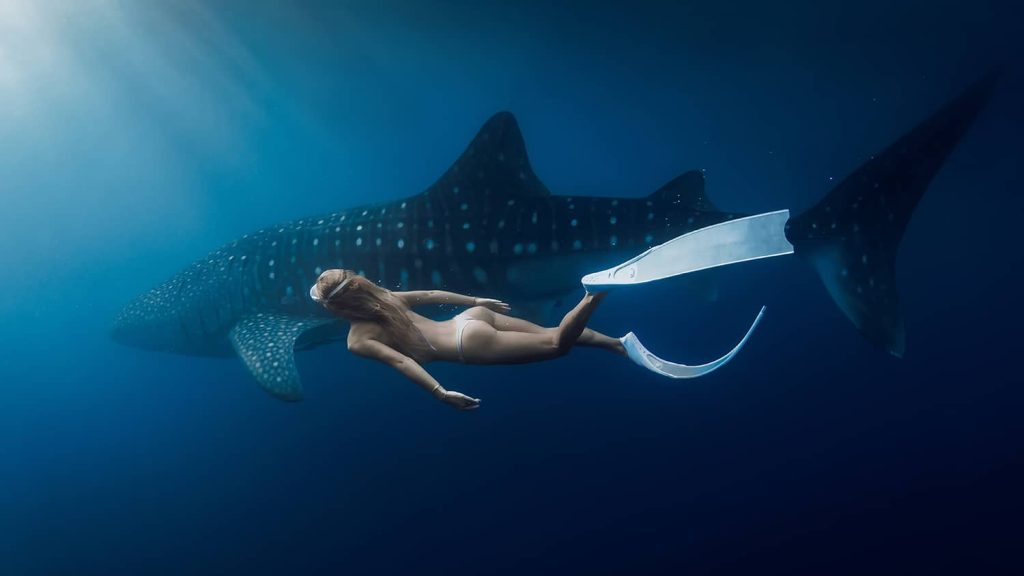
Saleh Bay in Sumbawa, Indonesia is a destination for whale shark encounters around local fishing platforms, known as bagan. Visitors can depart from Labuan Jambu to reach the bay. This guide explains access, timing, estimated costs, and preparation; sightings and boat departures remain subject to conditions on the day.
The natural question: how do you find whale sharks in such a vast area? The answer is more interesting than most guides tell you, and it involves a decades-old relationship between local fishermen and these gentle giants.
This guide covers everything: how to get there, when to go, what it costs, the ethics question, and honest insights from our team who has been guiding trips to Saleh Bay since 2017.
Ready to compare trips? Browse our Sumbawa whale shark tours by departure point, duration, and shared or private arrangements. Use this guide to understand the destination before choosing your itinerary.
1. About the Whale Sharks of Saleh Bay
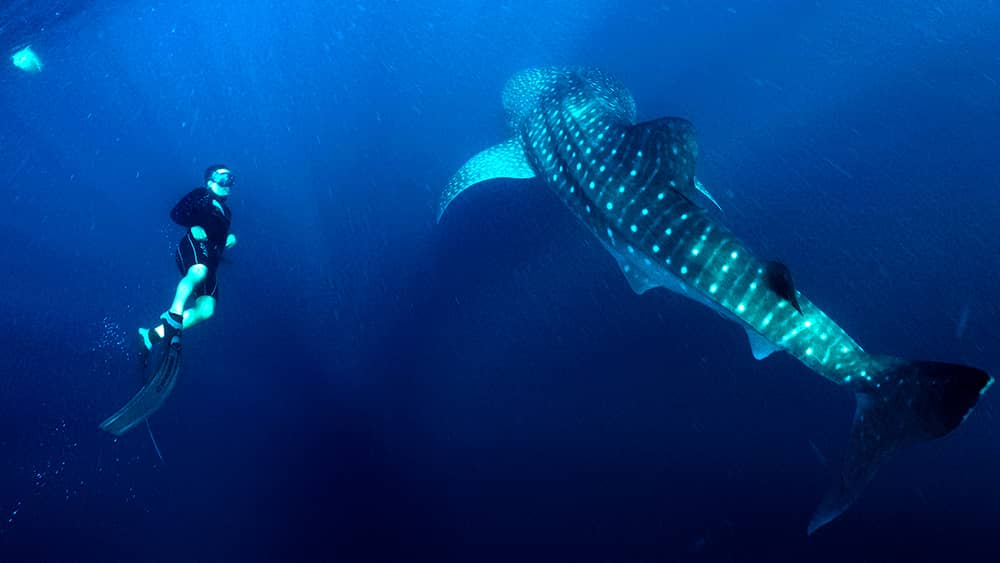
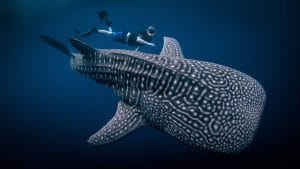
Whale sharks (Rhincodon typus) are the largest fish in the world. They can grow over 12 meters long, live up to 70–100 years, and feed on plankton, small fish, and shrimp. Despite their size, they are filter feeders and pose no danger to humans.
The species is listed as Endangered on the IUCN Red List since 2016. In Indonesia, whale sharks have been fully protected since 2013 under Ministerial Decree No. 18/2013, which prohibits any form of capture, trade, or exploitation.
What makes Saleh Bay scientifically and culturally significant: a 2024–2025 study by Conservation International recorded the first evidence of neonatal whale sharks (newborns measuring 135–145 cm) in Saleh Bay. This suggests the bay may serve as a pupping and nursery ground for whale sharks, placing Sumbawa firmly on the global map for whale shark conservation research.
A resident population of around 125 whale sharks has been documented in the area, and they stay year-round rather than migrating away seasonally.
1.1. The Story Behind “Pakek Torok”
Local Sumbawan fishermen have a name for whale sharks: “pakek torok”, which translates roughly to “the deaf shark.”
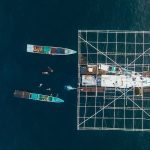
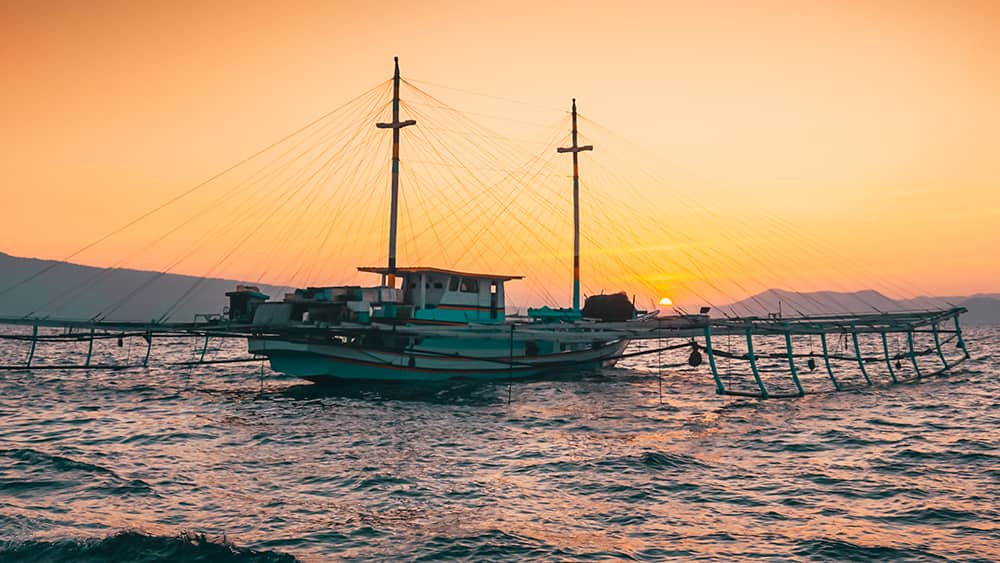
The name has a backstory. Long before whale shark tourism existed, fishermen in Saleh Bay used floating fishing platforms called bagan to catch small fish and squid at night, using bright lights to attract their catch. Each morning, when they pulled up their nets, whale sharks would arrive to feed on the plankton and small fish caught around the platform.
Sometimes whale sharks even swam directly into the nets. To fishermen back then, they were a nuisance. They tried to scare them off, sometimes even striking them, but the whale sharks would not budge. They simply ignored every attempt. From this came the name pakek torok: a shark that seems deaf.
This history matters because it points to something many guides miss: finding whale sharks at Saleh Bay is really about finding fishing platforms. Without bagan, whale sharks scatter across the entire 1,459 km² bay and become almost impossible to locate.
2. How to Get to Saleh Bay
2.1. Reaching Sumbawa Besar
Sumbawa is part of West Nusa Tenggara Province, located between Lombok and Flores. There are two main ways to get to Sumbawa:
- By air: Fly to Sultan Muhammad Kaharuddin III Airport in Sumbawa Besar (airport code: SWQ). There are direct flights from Lombok, Bali, and Jakarta, though schedules vary by season.
- By land and ferry from Lombok: Take a ferry from Kayangan Port in East Lombok to Poto Tano Port in West Sumbawa. The crossing takes about 2 hours, followed by a 2-hour drive to Sumbawa Besar.
2D1N Sumbawa Whale Shark Tour (Start & Finish Lombok)
From
IDR 1,070,000
per person
2.2. From Sumbawa Besar to Labuan Jambu Village
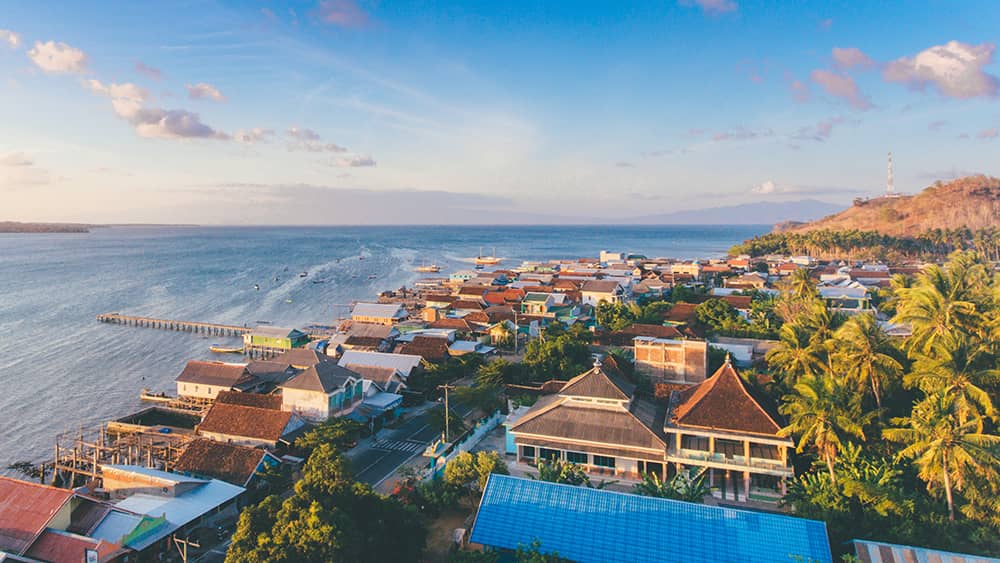
Labuan Jambu is a small fishing village in Tarano subdistrict, about a 3-hour drive from Sumbawa Besar. The village is the gateway to Saleh Bay’s whale sharks. Most visitors stay overnight here in homestays or local guesthouses for a more authentic experience and an early morning start.
Sumbawa Whale Shark Tour (Start & Finish Sumbawa Besar)
From
IDR 750,000
per person
2.3. From Labuan Jambu to the Bagan
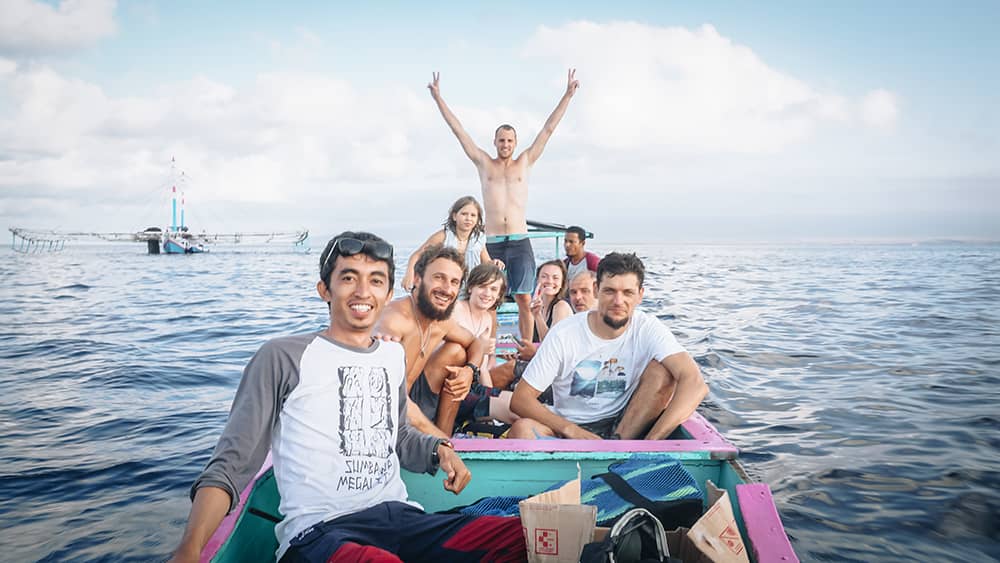
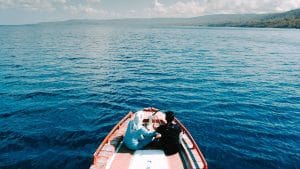
Whale sharks usually appear around 6 AM, when fishermen lift their nets. To catch them, you’ll need to leave the village around 4 AM by traditional fishing boat (called Begoq), with about a 2-hour ride to the bagan in Saleh Bay.
A local guide is highly recommended. Experienced guides communicate with bagan owners the night before to confirm which platforms are active and where whale sharks have been spotted. Without that intel, you could easily spend hours boat-hopping with nothing to show.
Sumbawa Whale Shark Open Trip Start From Labuan Jambu
From
IDR 650,000
per person
3. Best Time to Visit Saleh Bay
Whale sharks are present at Saleh Bay year-round, but the ideal window is April to November. During these months, the sea is calmer, visibility underwater is better, and the weather is consistent enough for early-morning boat rides.
Avoid January to March if you can. This is the peak rainy season, with rough waves and unpredictable weather. Many fishermen don’t go out, which means fewer bagan and far lower chances of seeing whale sharks.
3.1. The Full Moon Question
Older guides will tell you to avoid Saleh Bay during full moon, since fishermen used to stay onshore when the moon competed with their bagan lamps. That was true in the early years.
The reality has shifted. As whale shark tourism grew, more fishermen now keep their bagan operational throughout the lunar cycle, supplementing their fishing income with tourism. The full moon factor still exists, but it is no longer a hard barrier. Most days of the year are now viable for whale shark trips at Saleh Bay, weather permitting.
4. Cost of a Saleh Bay Whale Shark Trip
If you organize the trip independently, here’s a breakdown of typical costs:
- Local homestay: IDR 350,000 per person
- Meals: Around IDR 20,000 per meal at local warungs
- Begoq (fishing boat) rental: IDR 800,000 – 1,000,000 (capacity for 10 people, depending on bagan distance)
- Bagan owner and crew fee: IDR 1,500,000 per bagan
- Conservation fee: IDR 50,000 per person
- Entrance fee: IDR 50,000 per person (split between village fund and BUMDes)
- Local guide: IDR 500,000
These costs do not include transportation to Labuan Jambu. Traveling in small groups is the most cost-effective way to do this trip independently.
A portion of your fees, particularly the conservation and entrance fees, goes directly to the village fund and the local BUMDes (village-owned enterprise) to support conservation efforts and the local economy. This is one of the strongest arguments for visiting Saleh Bay: your trip contributes to the system that keeps whale sharks safe.
5. Rules for Interacting with Whale Sharks
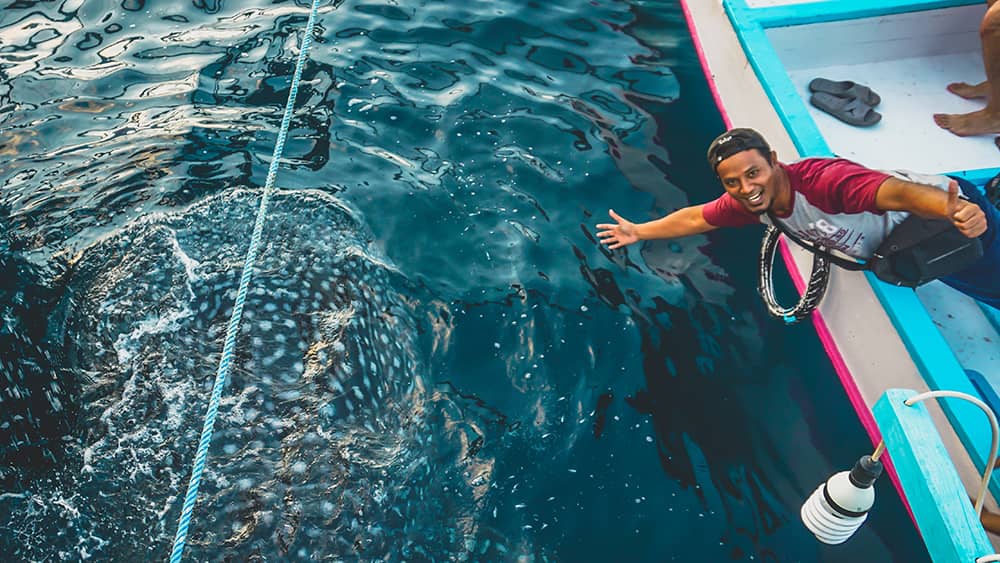
Saleh Bay has clear interaction protocols, both for your safety and the sharks’ wellbeing:
- Do not touch the whale sharks. Their placoid scales can cut you, and human contact can damage the protective mucus layer on their skin.
- Keep at least 3 meters from the body and 5 meters from the tail. A whale shark’s tail packs serious force.
- No camera flash. Bright flashes can disturb the animals and cause stress responses.
- Maximum 2 boats per whale shark. This rule helps reduce stress on the animals.
- Never block their swimming path. If a whale shark heads toward you, give way. Don’t chase or corner them.
- Always follow your guide’s instructions. They know the safe distances and the right positioning.
6. Is Saleh Bay Ethical? Honest Thoughts
If you’ve researched whale shark tourism in Asia, you’ve probably read about the controversy at Oslob in the Philippines, where operators feed whale sharks shrimp to keep them in one location for tourists. Most marine biologists view that as harmful: it disrupts natural feeding behavior, alters migration, and conditions wild animals to associate boats with food.
Saleh Bay works differently. Whale sharks are not deliberately fed by tourism operators. They come on their own, drawn to the small fish and plankton that gather around bagan nets. The fishermen are doing what they have done for generations: catching fish. Whale sharks happen to follow that food source. Tourism, in this case, is built on top of an existing ecological relationship rather than creating a new dependency.
That said, Saleh Bay is not without challenges. As tourism has grown, so has crowding at active bagan. Some days you might find five or six boats around a single platform. Conservation groups, including local communities like KAWAN Teluk Saleh and Conservation International, are working to develop sustainable management practices, but enforcement is still limited.
If you visit, you can do your part: choose operators committed to small group sizes, follow the rules strictly, give whale sharks space, and don’t push your guide to break protocol for a better photo.
7. From Our Team: What We’ve Learned Guiding Here Since 2017
We’ve been guiding whale shark trips at Saleh Bay for years, and a few patterns have stood out.
The most common one: first-time guests are usually scared. Seeing a 6–8 meter animal cruise underneath you on your first try in the water is intense. Almost everyone hesitates. But once our guides walk them through it slowly, most guests end up completely hooked. Some come back for second and third trips.
We also want to be straightforward about something many operators won’t say. Saleh Bay used to be quiet. A bagan would have one boat, sometimes two, and the experience was relaxed. It is much busier now, especially in peak season. Since 2018, we and a few other operators have proposed visitor quotas to local authorities to protect both the experience and the conservation goals. So far, no quota system has been formalized.
Because of this, we run mostly private trips, with a small number of strictly capped open trips. But here’s our honest disclosure: even on a private trip, we cannot guarantee that the bagan you visit will be empty. What we can do is stay flexible. Our guides communicate with multiple bagan owners and try to find the quietest active one, which works when whale sharks are present at several platforms. If they’re concentrated at just one, we ask for your understanding.
We think this transparency matters more than overpromising. A good whale shark trip is one that tells you the truth about field conditions.
8. Practical Tips Before You Go
8.1. Tips from Our Local Guides
- Eat breakfast before departure. Or ask your guide to prepare a packed meal. The trip starts very early and lasts most of the morning.
- Sun protection is essential. Begoq boats are mostly open. Ask your guide to bring a tarp for shade.
- Bring earplugs. The boat engine is louder than you’d expect.
- Stay calm in the water. If a whale shark approaches, don’t splash or panic. Move out of its path slowly.
- Be careful boarding and disembarking. Let the guide go first when stepping off and last when boarding back.
8.2. What to Pack
- Swimwear and a change of clothes
- Quick-dry towel
- Reef-safe sunscreen
- Hat and sunglasses
- A light jacket or windbreaker (early mornings on the boat are surprisingly cool)
- Underwater camera or GoPro
- Reusable water bottle
- Seasickness medication if you’re prone to it
- Dry bag for electronics
8.3. What If You Don’t See Any Whale Sharks?
It’s rare, but possible. Whale sharks are wild animals, not an attraction. They appear because of food, and food appears because of fishermen. Bad weather, no bagan, no whale sharks.
Our recommendation: build in at least 2 days at Saleh Bay, not one. If the first morning is unlucky, you have a second chance. Visit during the April–November window for the best odds.
9. Combining Saleh Bay with Other Sumbawa Highlights
If you’ve made the trip out to Sumbawa, it’s worth seeing more of the island while you’re here:
- Moyo Island — A small island known for the Mata Jitu waterfall, sometimes called Lady Diana’s waterfall after her visit there. It’s a natural addition to a whale shark trip.
- Mount Tambora — The volcano whose 1815 eruption changed global climate for an entire year. Strenuous trekking, but unforgettable.
- Kenawa Island — A tiny uninhabited island with one of the best sunset hilltop views in Indonesia.
Most of our guests pair Saleh Bay with Moyo Island for a 2–3 day combined trip, or build a longer itinerary that also includes Tambora.
Sumbawa Tour Package 3 Days 2 Nights (B)
From
IDR 2,240,000
per person
10. Frequently Asked Questions
Is swimming with whale sharks at Saleh Bay safe?
Yes, when you follow the rules. Whale sharks are filter feeders that eat plankton and small fish, and they are not aggressive toward humans. The main thing to be aware of is the powerful tail, not the mouth.
Do I need to be a strong swimmer?
You don’t need to be a strong swimmer, but you should be comfortable in the water and capable of basic snorkeling. Life jackets are available if you want extra confidence. If you’d rather not enter the water, you can also watch from the boat.
Saleh Bay vs Oslob vs Cenderawasih, which is best?
Saleh Bay and Cenderawasih (in Papua) both rely on natural feeding patterns, where whale sharks come to fishing platforms on their own. Oslob, in the Philippines, involves direct feeding by tourism operators, which is widely criticized by marine biologists. If ethics matters to you, Saleh Bay and Cenderawasih are the more responsible choices. Saleh Bay is more accessible from Bali and Lombok, while Cenderawasih requires a longer journey to West Papua.
Can I do this as a day trip from Lombok?
Technically yes, but it’s a long, exhausting day. The recommended route is at least one overnight in Labuan Jambu so you can leave for the bagan at 4 AM rested. A 2-day, 1-night package starting from Lombok is the most common option.
Can I scuba dive instead of snorkel?
Snorkeling is the standard activity here. Whale sharks feed near the surface around the bagan, so being above them on snorkel actually gives you a better view than being below them on scuba. Diving is technically possible but less effective for this experience.
How long do interactions usually last?
It varies. Some encounters last 15–30 minutes, others stretch over an hour. Whale sharks stay as long as food is around the bagan. We can’t predict exactly how long any single encounter will be.
Saleh Bay offers one of the most rewarding marine wildlife experiences in Southeast Asia: a chance to share the water with the largest fish in the world, in a place where the relationship between people and animals is older than the tourism industry around it. Bring an underwater camera, plan for at least two days, and arrive with realistic expectations.
Compare our Sumbawa whale shark tours by departure point, duration and shared or private options. For pickup in Sumbawa Besar, see the private 1-day tour from Sumbawa Besar.








I have plan to go there from 8.3-8.5.
Can I do snorkeling with whale shark in saleh?
And please tell me the price.
Hello, for reservation and fast response,;please contact us via WA at +6282144356010.Thank you
selamat sore
we (2 persons) are interested in seeing the whaleshark the 15 of august, that is Tuesday morning.
We would like to join another group of persons if posible to make it a bit cheaper.
We are at Mojo island now and tomorrow afternoon we can be in Labuan Jambo.
Is it posible to arrange this trip and how much will it cost?
greetings
Hello, for reservation and fast response,;please contact us via WA at +6282144356010.Thank you
Hi
Is December 16, 2025, a good time to see the whale sharks?
I understand that December 20 is a full moon, and the fisherman won’t be feeding them. The fisherman usually takes off one week before or after the full moon. We want to know when the fisherman will be active to have a better chance to see the whale sharks
Hi, for more details, kindly contact us via WA at +6282144356010