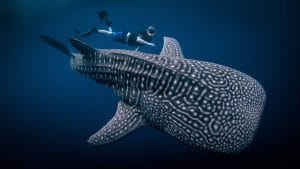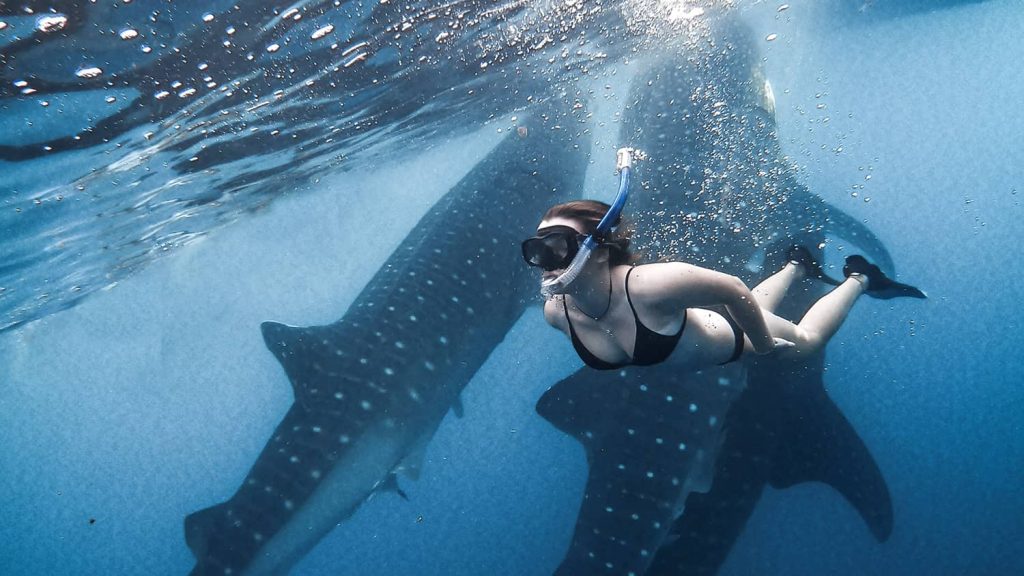
“Are the whale sharks fed?” “Is this one of those places that baits them in for tourists?” “Am I harming them by coming?” We hear these questions every single week — and they deserve better than a reassuring one-liner.
Full disclosure first: we are a local operator and have run whale shark trips in Saleh Bay for more than eight years, so we have a commercial interest in your answer being “yes, come.” That’s exactly why we’ve written the honest version — the history, the research, what happens on the water, and the one problem our industry still hasn’t solved.
Why Whale Sharks Gather in Saleh Bay at All
Saleh Bay is the largest bay on Sumbawa, and hundreds of traditional bagan fishing platforms work its waters at night. When the crews lift their nets before sunrise, clouds of small baitfish slip free — and whale sharks come in to feed on them. Because the bagans operate most of the year, the sharks stay most of the year. This is not a migration stop that tourism discovered; it’s a working fishery that whale sharks learned to follow decades ago.
Are They Fed? Yes, No, and It’s Complicated
Here’s the part most tour websites skip. During visits, fishermen do release part of the night’s small catch back into the water, little by little, while guests swim. So no — we won’t tell you the sharks are “never fed.” What we can tell you is the context that makes Saleh Bay different: the food and the sharks were here first, and tourism arrived later. Elsewhere in the world, some famous sites hand-feed daily specifically to hold wild animals in place for visitors; that is not how this bay came to be.
Researchers studying Saleh Bay’s whale sharks describe what the animals take at the platforms as a morning snack, not a meal plan. The sharks continue ranging and foraging naturally across the bay — the baitfish at the bagans is a top-up on a routine they have kept for generations of fishermen.
From Speared Pest to Village Treasure
The relationship between fishermen and whale sharks here was not always gentle. For generations, a whale shark inside the net meant torn gear and a lost night’s work — crews treated them as pests and drove them out by force, sometimes with spears. Tourism flipped that economy completely. Today, a bagan crew will tear open its own net to free an entangled whale shark, because a living shark is now worth far more to the village than any single catch. Whatever your view on baitfish and bagans, that reversal has been unambiguously good for a species listed as endangered on the IUCN Red List.
The bay keeps proving it matters, too: scientists have even confirmed the discovery of a baby whale shark in Saleh Bay — a hint that these waters may play a bigger role in the species’ life cycle than a feeding stop.
The Problem Nobody Has Solved: Crowding
Now the uncomfortable part. There is still no official cap on how many boats or swimmers can be in Saleh Bay on a given morning. We have been pushing for agreed visitor limits since 2018, together with anyone willing to sit at the table — and so far, the industry has not reached a deal. On busy mornings, that can mean more people around a bagan than we would like.
We can’t fix that alone, and we won’t pretend otherwise. What any single operator can control is its own conduct: a proper briefing before anyone enters the water, clear interaction rules, and the discipline to follow them even when other boats don’t.
What Ethical Swimming Looks Like
Wherever you swim with whale sharks — here or anywhere in Indonesia — the code is the same:
- Listen to the briefing before you enter the water — then actually follow it.
- Never touch the animal: it causes stress and can damage the protective layer on its skin.
- Keep a few meters of distance and never block the shark’s path — let it set the pace.
- No flash photography.
- Not a strong swimmer? Wear the life jacket — every boat carries them.
What We Do — and What We Can’t Do Alone
Our trips are built around the bay’s natural rhythm: we depart pre-dawn when the sharks feed around the bagans, our team follows platform activity across the bay. Every trip starts with a safety and interaction briefing, and our departures from Sumbawa Besar are led by our own licensed guides with a dedicated trip leader on board.
One more thing we do on purpose: we don’t promise a guaranteed sighting. Across eight-plus years, more than 95% of our guests have swum with at least one whale shark — and on the rare morning they don’t show, we discuss a partial refund or a free reschedule. We’d rather under-promise than quietly turn a wild animal into a guaranteed product.
So — Should You Come?
Our honest verdict: yes, with the right expectations and the right behavior. Your visit funds the exact economics that turned whale sharks from speared pests into protected neighbors, and the encounter itself grew out of a fishery, not a tourist trick. The open questions — crowding above all — are real, and choosing an operator that briefs, follows the rules, and pushes for limits is the most ethical lever you have. April to November is the sweet spot for calm seas and clear water.
If you want to see how a trip works in practice, start with our Sumbawa whale shark tours page — prices, the sighting calendar, and the same honest answers as this essay — or jump straight to the shared open trip from Labuan Jambu if you’re traveling solo.
FAQ: Whale Shark Ethics in Saleh Bay
Are the whale sharks in Saleh Bay wild?
Completely. They are free-swimming animals in an open bay — no enclosures, no barriers — and they come and go as they please. That’s why our encounter rate is 95%+, not 100%.
Are the whale sharks fed to attract them?
Fishermen release small amounts of baitfish while lifting their nets at dawn — the same dynamic that has drawn whale sharks to the bagan platforms for decades, since long before tourism. Researchers describe what the sharks take there as a morning snack rather than a diet; they keep foraging naturally across the bay.
Is it harmful to swim with them?
Not inherently. The harm comes from behavior: touching, flash photography, blocking the animal’s path, or crowding it. Follow the briefing, keep a few meters of distance, and let the shark set the pace.
Why is there no limit on the number of visitors?
Because the operators of Saleh Bay have never reached an industry-wide agreement. We have been advocating for visitor caps since 2018 and will keep pushing. Until rules exist, the practical answer is to choose an operator that briefs its guests and enforces the interaction rules.
Can you touch a whale shark?
No. Touching stresses the animal and can damage the protective layer on its skin — and it’s the first rule of every briefing before you enter the water.